Thermal boundary resistance at metal/GaN interfaces can be significant: Congrats Brian Donovan

Brian Donovan’s paper, “Thermal boundary conductance across metal-gallium nitride (GaN) interfaces from 80 – 450 K,” has been published in Applied Physics Letters (Appl. Phys. Lett. 105, 203502 (2014)).    In this work, we show that the thermal boundary conductance across metal/GaN interfaces can impose a thermal resistance similar to that of GaN/substrate interfaces. We also show that these thermal resistances decrease with increasing operating temperature and can be greatly affected by inclusion of a thin adhesion layers.  Congrats Brian!!!

Abstract

Thermal boundary conductance is of critical importance to gallium nitride (GaN)-based device performance. While the GaN-substrate interface has been well studied, insufficient attention has been paid to the metal contacts in the device. In this work, we measure the thermal boundaryconductance across interfaces of Au, Al, and Au-Ti contact layers and GaN. We show that in these basic systems, metal-GaN interfaces can impose a thermal resistance similar to that of GaN-substrate interfaces. We also show that these thermal resistances decrease with increasing operating temperature and can be greatly affected by inclusion of a thin adhesion layers.

The material is based upon the work partially supported by the Air Force Office of Scientific Research under AFOSR Award No. FA9550-14-1-0067 (Subaward No. 5010-UV-AFOSR-0067) and the National Science Foundation (CBET-1339436). This work was partially supported by the Commonwealth Research Commercialization Fund (CRCF) of Virginia. Sandia National Laboratories is a multiprogram laboratory managed and operated by Sandia Corporation, a wholly owned subsidiary of Lockheed Martin Corporation, for the U.S. Department of Energy National Nuclear Security Administration under Contract No. DE-AC04-94AL85000.

Glass-like thermal conductivity of crystalline strontium niobate; a crystalline solid synthesized with solution chemistry: Congrats Brian Foley!

Brian Foley’s paper, “Glass-like thermal conductivity of (010)-textured lanthanum-doped strontium niobate synthesized with wet chemical deposition,” has been published in the Journal of the American Ceramic Society (DOI: 10.1111/jace.13318).    In this work, we have demonstrated that solution-based chemistry can produce highly textured, single crystalline oxide-films of strontium niobate with ultra-low thermal conductivities.  the low thermal conductivities originate due to the variable and layered bonding environments in this perovskite structure.  Congrats Brian!!!

Abstract

We have measured the cross-plane thermal conductivity (κ) of (010)-textured, undoped, and lanthanum-doped strontium niobate (Sr2−xLaxNb2O7−δ) thin films via time-domain thermoreflectance. The thin films were deposited on (001)-oriented SrTiO3 substrates via the highly-scalable technique of chemical solution deposition. We find that both film thickness and lanthanum doping have little effect on κ, suggesting that there is a more dominant phonon scattering mechanism present in the system; namely the weak interlayer-bonding along theb-axis in the Sr2Nb2O7 parent structure. Furthermore, we compare our experimental results with two variations of the minimum-limit model for κ and discuss the nature of transport in material systems with weakly-bonded layers. The low cross-plane κ of these scalably-fabricated films is comparable to that of similarly layered niobate structures grown epitaxially.

B.M.F. is grateful for support from the ARCS Foundation Metro Washington Chapter. P.E.H. is appreciative for funding through the Army Research Office (W911NF-13-1-0378) and the NSF EAGER program (CBET-1339436). This work was performed in part at the Center for Atomic, Molecular, and Optical Science (CAMOS) at the University of Virginia. This work was supported, in part, by the Laboratory Directed Research and Development (LDRD) pro- gram at Sandia National Laboratories (H.B-S., M.J.C., D.L.M., P.G.C, J.F.I., P.E.H.). Sandia National Laboratories is a multi-program laboratory managed and operated by Sandia Corporation, a wholly owned subsidiary of Lockheed Martin Corporation, for the U.S. Department of Energy’s National Nuclear Security Administration under contract DE-AC04-94AL85000. This project was supported by Financial Assistance Award No. 01-79-14214, awarded by U.S. Department of Commerce Economic Development Adminis- tration, to the University of Virginia (P.E.H, B.M.F). The content is solely the responsibility of the authors and does not necessarily represent the official views of the U.S. Department of Commerce Economic Development Administration.

Low thermal conductivity of nano-grained BaTiO3 – Congrats Brian Donovan!

Brian’s paper, “Spectral phonon scattering effects on the thermal conductivity of nano-grained barium titanate,” has been published in Applied Physics Letters (Appl. Phys. Lett. 105, 082907 (2014)).  In this work, we show that grain sizes as large as 50 nm can still lead to reductions in the thermal conductivity of BaTiO3 thin films.  For films with grain sizes of 36 nm (on average), the thermal conductivity of the BaTiO3 thin film can reach as low as 1.0 W/m/K.  We attribute this reduction in thermal conductivity to the spectral nature of phonon mean free paths in BaTiO3, with some phonons having mean free paths larger than the grain sizes (which, in our samples, range from 36-63 nm).  This is in contrast to the typically assumed view of phonon transport in ABO3 perovskite ferroelectrics in which gray phonon mean free paths are assumed with length scales less than 5 nm.  Congrats Brian!!!

Abstract

We study the effect of grain size on thermal conductivity of thin film barium titanate over temperatures ranging from 200 to 500 K. We show that the thermal conductivity of BariumTitanate (BaTiO) decreases with decreasing grain size as a result of increased phononscattering from grain boundaries. We analyze our results with a model for thermal conductivitythat incorporates a spectrum of mean free paths in BaTiO. In contrast to the common gray mean free path assumption, our findings suggest that the thermal conductivity of complex oxide perovskites is driven by a spectrum of phonons with varying mean free paths.

We appreciate funding from the National Science Foundation (CBET-1339436), the Army Research Office, Grant No. W911NF-13-1-0378, and the Air Force Office of Scientific Research under AFOSR Award No. FA9550-14-1-0067 (Subaward No. 5010-UV-AFOSR-0067). This work was also supported, in part, by the Laboratory Directed Research and Development (LDRD) program at Sandia National Laboratories.

Polarization-dependent phonon transmission based on wetting at solid/liquid interfaces published in APL – Congrats Ash!

Ash’s paper, “Spectral analysis of thermal boundary conductance across solid/classical liquid interfaces: a molecular dynamics study,” has been published in Applied Physics Letters (Appl. Phys. Lett. 105, 033106 (2014)).  In this work, we use molecular dynamics simulations to show that the adhesion between a solid and a liquid (macroscopically referred to as the degree of wetting) has a pronounced spectral effect on phonon transmission, drastically affecting the transmission of low frequency modes across solid liquid interfaces.  This quantifies, from an atomistic perspective, how wetting affects thermal boundary conductance across solid/liquid interfaces.  Congrats Ash!!!

Abstract

We investigate the fundamental mechanisms driving thermal transport across solid/classical-liquid interfaces via non-equilibrium molecular dynamics simulations. We show that the increase in thermal boundary conductance across strongly bonded solid/liquid interfaces compared to weakly bonded interfaces is due to increased coupling of low-frequency modes when the solidis better wetted by the liquid. Local phonon density of states and spectral temperature calculations confirm this finding. Specifically, we show that highly wetted solids couple low frequency phonon energies more efficiently, where the interface of a poorly wetted solid acts like free surfaces. The spectral temperature calculations provide further evidence of low frequency phonon mode coupling under non equilibrium conditions. These results quantitatively explain the influence of wetting on thermal boundary conductance across solid/liquid interfaces.

We appreciate support from the Office of Naval Research Young Investigator Program (Grant No. N00014-13-4-0528).

Ion irradiation, damage and interfacial mixing increases thermal boundary conductance

Caroline’s paper, “Ion irradiation of the native oxide/silicon surface increases the thermal boundary conductance across aluminum/silicon interfaces,” has been published in Physical Review B (Phys. Rev. B 90, 024301 (2014)).  In this work, we demonstrate that mixing and damage resulting from ion irradiation can INCREASE the thermal boundary conductance across Al/native oxide/Si interfaces.  This counter intuitive result shows that “less perfect” interfaces can be better conductors (i.e., have less resistance) than compositionally abrupt, more “perfect” interfaces.  We wish Caroline all the best in her PhD pursuits with Prof. Alan McGaughey at CMU.  Congrats Caroline!!

Abstract

The thermal boundary conductance across solid-solid interfaces can be affected by the physical properties of the solid boundary. Atomic composition, disorder, and bonding between materials can result in large deviations in the phonon scattering mechanisms contributing to thermal boundary conductance. Theoretical and computational studies have suggested that the mixing of atoms around an interface can lead to an increase in thermal boundary conductance by creating a region with an average vibrational spectra of the two materials forming the interface. In this paper, we experimentally demonstrate that ion irradiation and subsequent modification of atoms at solid surfaces can increase the thermal boundary conductance across solid interfaces due to a change in the acoustic impedance of the surface. We measure the thermal boundary conductance between thin aluminum films and silicon substrates with native silicon dioxide layers that have been subjected to proton irradiation and post-irradiation surface cleaning procedures. The thermal boundary conductance across the Al/native oxide/Si interfacial region increases with an increase in proton dose. Supported with statistical simulations, we hypothesize that ion beam mixing of the native oxide and silicon substrate within ∼2.2 nm of the silicon surface results in the observed increase in thermal boundary conductance. This ion mixing leads to the spatial gradation of the silicon native oxide into the silicon substrate, which alters the acoustic impedance and vibrational characteristics at the interface of the aluminum film and native oxide/silicon substrate. We confirm this assertion with picosecond acoustic analyses. Our results demonstrate that under specific conditions, a “more disordered and defected” interfacial region can have a lower resistance than a more “perfect” interface.

We appreciate support from the Office of Naval Research Young Investigator Program (Grant No. N00014-13-4-0528), the Army Research Office (Grant No. W911NF-13-1-0378), and the Laboratory Directed Research and Development (LDRD) program at Sandia National Laboratories. Addition- ally, the authors acknowledge John Bradley for allowing use of the 80-300 Titan S/TEM at Lawrence Livermore National Laboratory. Sandia is a multiprogram laboratory managed and operated by Sandia Corporation, a wholly owned subsidiary of Lockheed Martin Corporation, for the US Department of Energy’s National Nuclear Security Administration under Contract No. DE-AC04-94Al85000.

Patrick selected as a 2014 National Finalist for the Blavatnik Award for Young Scientists

Patrick has been selected by the Blavatnik Family Foundation as a 2014 National Award Finalist for the Blavatnik Award for Young Scientists in the area of Physical Sciences and Engineering.  This is the inaugural year for the National Award, which will honor three scientists under the age of 42 from leading research universities and academic medical centers in chemistry, life sciences, and physical sciences and engineering with the $250,000 prize.  The national faculty competition of the Blavatnik Awards for Young Scientists recognizes the country’s most promising young faculty-rank scientists and engineers in the disciplinary categories of Life Sciences, Physical Sciences & Engineering, and Chemistry.  More information can be found here: http://blavatnikawards.org/news/items/blavatnik-national-awards-announce-30-finalists/

Hot electron scattering at interfaces – Paper accepted into Journal of Heat Transfer (Congrats Ash Giri)!

Ash’s paper, “Influence of hot electron scattering and electron-phonon interactions on thermal boundary conductance at metal/non-metal interfaces,” has been accepted for publication into the Journal of Heat Transfer.  In this work, we present a coupled thermodynamic and quantum mechanical derivation of electron-phonon scattering at free electron metal/non-metal substrate interfaces.  A simplified approach to the Fermi’s Golden Rule with electron energy transitions between only three energy levels is adopted to derive an electron-phonon diffuse mismatch model, that account for the electron-phonon thermal boundary conductance at metal/insulator interfaces increases with electron temperature.  Our approach demonstrates that the metal-electron/non-metal phonon conductance at interfaces can be an order of magnitude larger than purely phonon driven processes when the electrons are driven out of equilibrium with the phonons, consistent with recent experimental observations.

This work was supported by the Air Force Office of Scientific Research Young Investigator Program.

Brian Foley wins Graduate STEM Research Fellowship from VSGC!

Brian was recently awarded a Graduate STEM Research Fellowship for 2014-2015 by the Virginia Space Grant Consortium (VSGC).  The title of his research proposal was the “Experimental investigation of thermal hot-spot generation in high-frequency transistors due to non-equilibrium electron-phonon energy transfer”, in which he will study the interactions between electrons moving in a semiconductor and the atoms that comprise the semiconductor while under operation.  This transfer of energy between the moving electrons and the semiconductor lattice results in an increased crystal temperature within the semiconductor, which can ultimately lead to the catastrophic failure of the device.  Brian’s goal is to better understand the fundamental mechanisms of these energy transfer processes on the nanoscale to help device engineers take a more “thermal-first” approach in future designs.  Congrats Brian!

Thermal conductivity of water-insoluble solid proteins – Paper published in Journal of Physical Chemistry Letters (Congrats Brian Foley)!

We have reported the first measurements of the thermal conductivity of films of water-insoluble solid protein films.  These measurements allow us to evaluate the heat transfer mechanisms in proteins, and evaluate models and hypotheses based on how thermal vibrations transport energy in fractal geometries.  Our work was recently published in Journal of Physical Chemistry Letters (“Protein thermal conductivity measured in the solid state reveals anharmonic interactions of vibrations in a fractal structure,” Journal of Physical Chemistry Letters DOI: 10.1021/jz500174x).  Congratulations to Brian Foley who is the first author on this work!!! This work summarizes collaborations with Brian Kaehr at Sandia National Laboratories and University of New Mexico along with Prof. Costel Constantin at James Madison University.  We all appreciate the generous support from the Office of Naval Research (YIP), U.S. Department of Energy (DOE), Office of Science, Office of Basic Energy Sciences (BES), Division of Materials Sciences and Engineering, the Commonwealth Research Commercialization Fund (CRCF) of Virginia and the 4-VA mini-grant for university collaboration in the Commonwealth of Virginia.

Abstract

Energy processes and vibrations in biological macromolecules such as proteins ultimately dictate biological, chemical, and physical functions in living materials. These energetic vibrations in the ribbon-like motifs of proteins interact on self-similar structures and fractal-like objects over a range of length scales of the protein (a few angstroms to the size of the protein itself, a few nanometers). In fact, the fractal geometries of protein molecules create a complex network of vibrations; therefore, proteins represent an ideal material system to study the underlying mechanisms driving vibrational thermal transport in a dense, fractal network. However, experimental studies of thermal energy transport in proteins have been limited to dispersive protein suspensions, which limits the knowledge that can be extracted about how vibrational energy is transferred in a pure protein solid. We overcome this by synthesizing solid, water-insoluble protein films for thermal conductivity measurements via time-domain thermoreflectance. We measure the thermal conductivity of bovine serum albumin and myoglobin solid films over a range of temperatures from 77 to 296 K. These temperature trends indicate that anharmonic coupling of vibrations in the protein is contributing to thermal conductivity. This first-ever observation of anharmonic-like trends in the thermal conductivity of a fully dense protein forms the basis of validation of seminal theories of vibrational energy-transfer processes in fractal objects.

P.E.H. appreciates financial support from the Office of Naval Research (N00014-13-4-0528). B.K. acknowledges support from the U.S. Department of Energy (DOE), Office of Science, Office of Basic Energy Sciences (BES), Division of Materials Sciences and Engineering. This work was partially supported by the Commonwealth Research Commercialization Fund (CRCF) of Virginia and the 4-VA mini-grant for university collaboration in the Commonwealth of Virginia. Sandia National Laboratories is a multiprogram laboratory managed and operated by Sandia Corporation, a wholly owned subsidiary of Lockheed Martin Corporation, for the U.S. Department of Energy National Nuclear Security Administration under contract no. DE-AC04-94AL85000.

Brian Foley and Brian Dononvan take First and Second Place in student presentation competition at EMA 2014!

Brian Foley and Brian Donovan were awarded first and second place for student presentations at the Electronic Materials and Applications Conference this year.  Brian Foley presented work on the glass-like thermal conductivity of fully-crystalline Strontium Niobate thin films.  Through his measurements made using time-domain thermoreflectance experiments, he was able to show that the interfaces between adjacent slabs of octahedra in the naturally-layered structure are the dominant phonon scattering mechanism.  Brian Donovan presented work on grain size effects on thermal conductivity of Barium Titanate.  Using time-domain thermoreflectance he showed that thermal conductivity was limited by grain size and film thickness of the material system.  Congrats to the Brians!

IMG_7770Brian Foley receiving 1st place award at EMA 2014 banquet.

IMG_7766Brian Donovan receiving 2nd place award at EMA 2014 banquet.

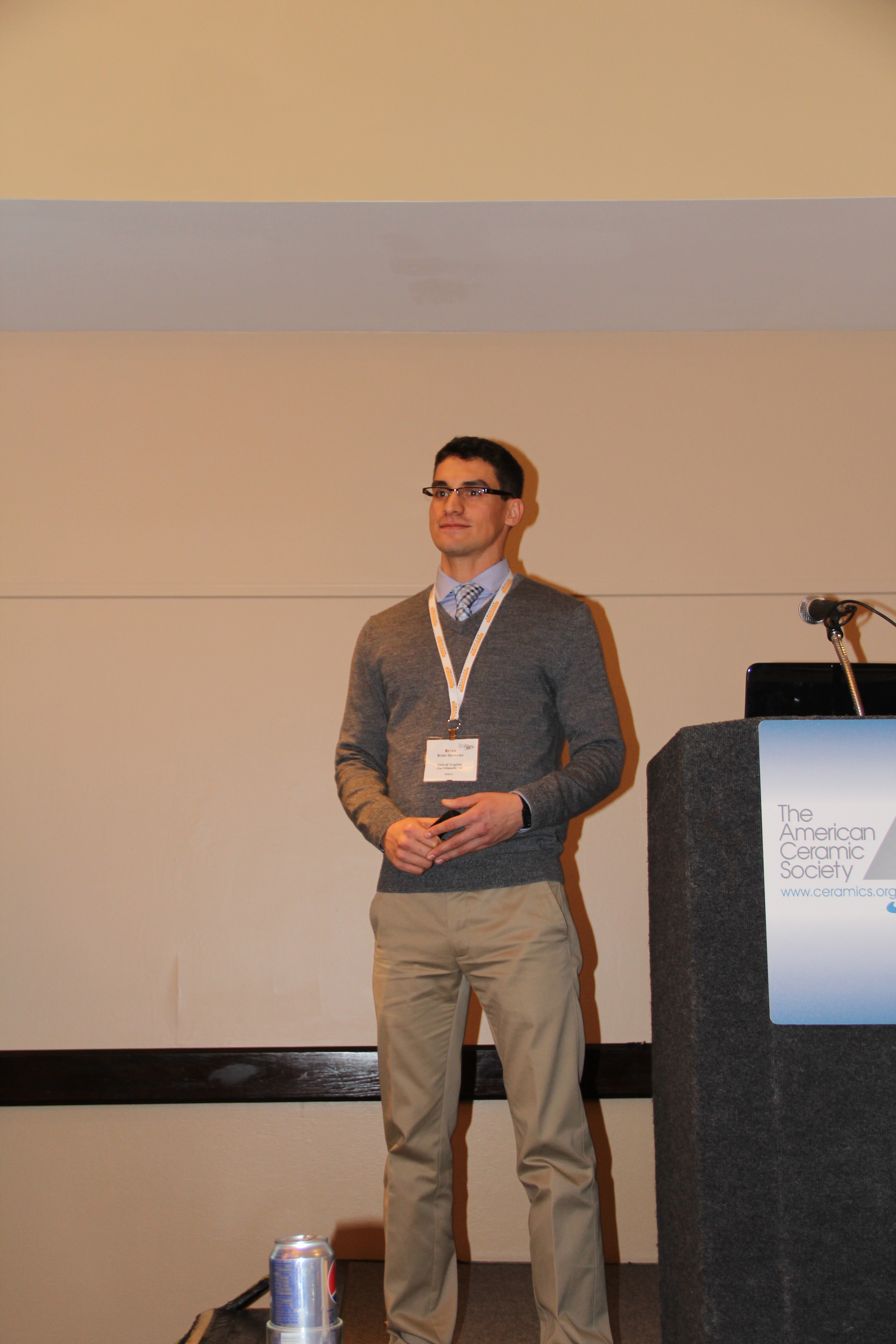
IMG_7680Brian Donovan is quite proud after just finishing his first oral presentation as a U.Va. grad student.